
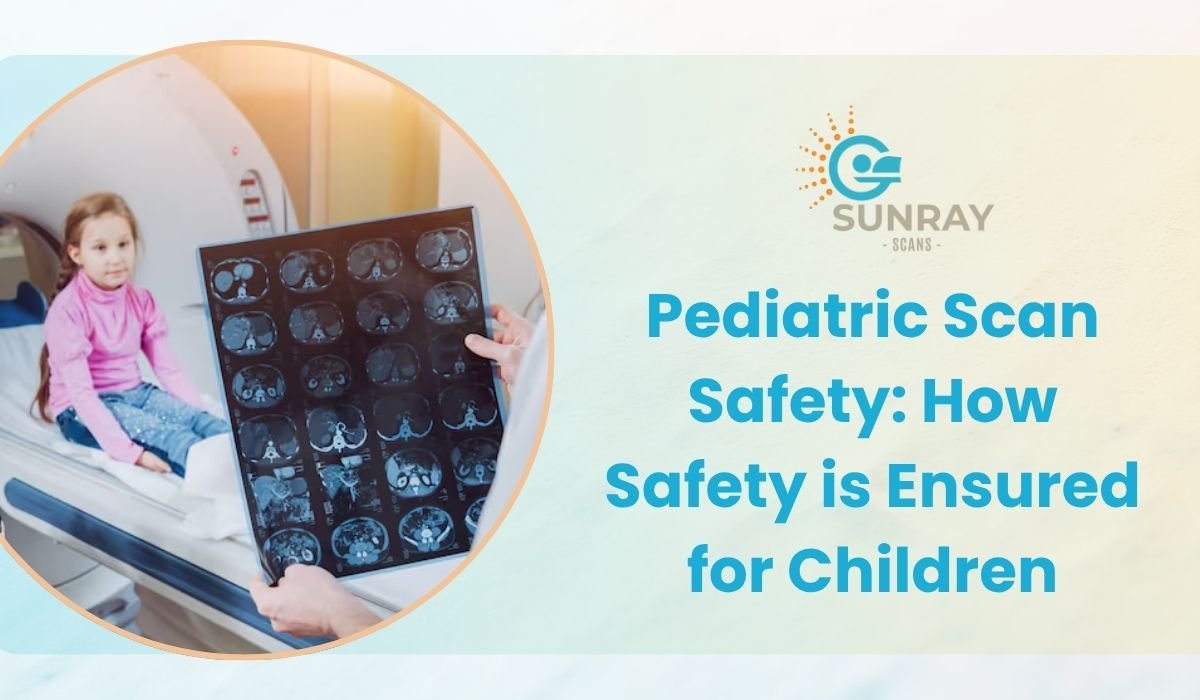
For any parent, the well-being of their child ranks first in importance. If your child needs a diagnostic scan, there is no end to questions regarding the influence of radiation, the level of cooperation from the child during the procedure, and so on. We at Sunrayscan fully understand your concerns and provide services without compromising pediatric scan safety.
We aim to help you gain a better understanding of the protocols used in order to provide the best diagnostic scans for children possible, making them not only more effective but also stress-free and comfortable for the little ones.
Understanding Pediatric Scans: The Need and the Technology
Imaging modalities are very important for physicians when making an internal body diagnosis. They can vary from basic procedures like X-ray and ultrasound to complicated imaging technologies such as Computed Tomography (CT) and Magnetic Resonance Imaging (MRI). There are distinct safety precautions required based on the kind of procedure being performed. Although ultrasounds and MRIs are not exposed to ionising radiations, X-rays and CTs are. Hence, there is a need for different ways of pediatric scan safety.Safety Measures in Radiation-Based Scans: X-rays and CT Scans
The primary concern with CT scans and X-rays is the exposure to ionising radiation. While these scans provide invaluable, detailed views of internal structures, it’s essential to manage radiation exposure carefully, especially in children, whose bodies are more sensitive to its effects.ALARA – As Low As Reasonably Achievable Principle
The concept of ALARA underlies everything we do when taking pediatric X-rays and CTs. We aim at minimising the dose used for scanning while ensuring good quality diagnostic images. The measures we apply to achieve the best results include:- The Use of Child-Specific Protocols: A child’s body is not identical to that of an adult’s. That’s why at Sunrayscan, we use specific settings priorly in our CT and X-ray machines that automatically adjust the dose according to children’s weight and size. We can achieve a much lower dose for our pediatric clients than for adults because of the pre-set protocols in place.
- Technique Selection: Our experts are always careful to select the appropriate technique to ensure the minimum amount of radiation involvement for achieving the best results possible.
- Field of View Limitation: Radiation is used only on those body parts that need examination.
Advancements: The Era of Low Radiation CT for Kids
Efforts have been made by modern imaging techniques to minimise the amount of radiation. It uses iterative reconstruction, a complicated computer process involved in image acquisition, that enables us to acquire images with very little radiation dose. The iterative reconstruction technique plays an important role in low radiation CT scans for kids.Safety and Comfort Measures in Non-Radiation Scans: MRI
Although there is no exposure to radiation while performing an MRI, it presents a unique set of problems when it comes to children. With the extended duration of the MRI process, the requirement to remain completely motionless, and the loud noise that emanates from it, the entire process can become quite stressful for a child. Here is what is done at Sunrays Scans to overcome these hurdles of pediatric scan.- Making the MRI Environment Child-Friendly
- Preparation and Minimising Distortion
- Using Technology and Comfort Assistance, such as soothing music and cartoons
- Using fast scanning techniques
- Using anaesthesia to ensure they remain stationary
The Team Approach: Following Pediatric Imaging Guidelines
Pediatric scan safety is not the responsibility of a single individual; it’s a team effort. This team includes pediatric radiologists, radiologic technologists, pediatric anesthesiologists, nursing staff, and you, the parent. We adhere strictly to international and national pediatric imaging guidelines which are designed to ensure the highest quality images with the lowest possible radiation dose for radiation-based scans, and the maximum safety and comfort for all pediatric imaging. This standardised, careful approach guarantees consistent safety and quality for every child who comes through our doors.Communicating with Your Healthcare Team: A Parent’s Role
You are vital in this health care team. Feel free to ask any question. Below are those you may need to ask your referring physician or the imaging center:- What is the aim of this examination? How does it contribute to the diagnosis or management of your condition?
- Are there other forms of scans (ultrasound, MRI) that do not have any radiation?
- What are the measures in place to reduce radiation (CT or X-ray scan) or increase patient comfort (MRI)?
- Do they offer child-oriented scanning protocols?
Why Choose Sunrayscan for Your Child’s Imaging Needs
As a parent, when you take your child for an imaging test, your child must receive the best scanning done in the hands of professionals who have his/her safety at heart. The best centre for your child’s scan is at Sunrayscan, where he/she will be in safe hands. Parents prefer Sunrayscans because we understand your worries and offer you the following services.- Highly skilled radiologists and technologists who specialize in pediatrics: Our professional staff is trained and experienced in conducting scans on children of different age groups. They ensure that your child feels as comfortable as possible in the process.
- We use the latest technology equipment like child friendly MRI machines that have features that make scanning easier for children, and CT scanners that have a low radiation CT for kids.
- At Sunrayscan, we ensure that all equipment used to conduct a scan is designed for children.
- At Sunrayscan, we follow all the recommended pediatric imaging protocols.
- A compassionate team that puts your child’s best interest first: We understand that you and your child may be under a lot of stress, and