
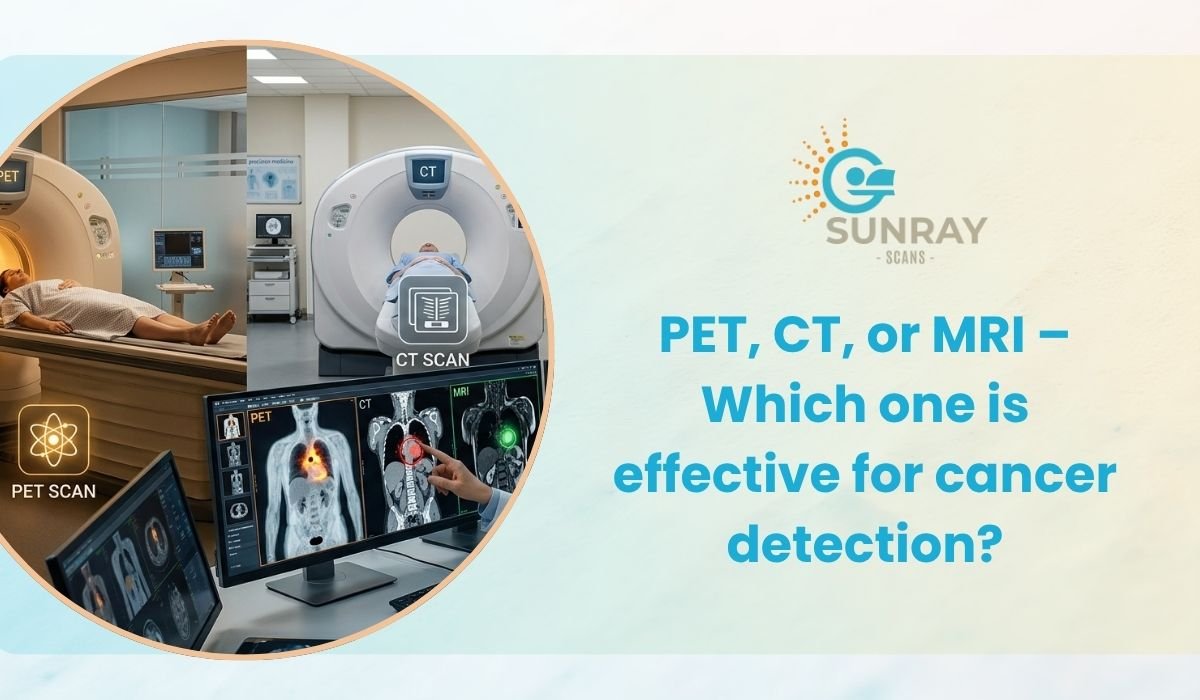
A cancer patient’s experience usually begins with one simple query – “Which scan gives the most precise results?” As far as oncology is concerned, scans act as beacons of hope in the dark ocean of treatment. With all the medical jargons involved, such as PET, CT, or MRI, it can become overwhelming for a patient and their caretaker.
If you are looking for advanced cancer imaging techniques or searching for the safest scan for cancer diagnosis, then it is important for you to understand the procedure behind such scans. Not all scans are suitable for all kinds of cancer.
At Sunray Scans, Chennai, we believe that clarity is the first step for healing, and we explain it to our patients. We have tailored scan procedures for the three major types of cancer, which makes us stand out from other scan centres.
CT Scan: The Anatomical Architect
Computed Tomography (CT) forms the backbone of modern medicine. With its ability to capture several X-ray images from various angles, it forms cross-sectional views, or slices, of the human body.- How it works: It identifies the physical architecture, i.e., the skeletal frame, the internal organs, and any physical masses.
- When it excels: Finding the size, shape, and location of any tumours. It performs remarkably well in detecting lung cancer, identifying bone metastases, and determining whether a tumour has metastasised to other organs.
- What sets it apart: The speed. During an emergency staging process, a CT can capture scans of the entire body within minutes.
- The caveat: Ionising radiation. Modern devices (such as the ones used by Sunray Scans) employ a “low dose” protocol.
MRI: The Soft Tissue Specialist
Whereas CT scans are concerned with the map, MRI technology concentrates on the texture. The technique involves using strong magnets and radio waves to capture images of internal body structures with precision.- How it works: MRI technology involves aligning hydrogen atoms in your body to provide high-resolution images without any radiation exposure.
- Best for: Diagnosis of brain tumours, spinal cord disorders, breast cancer, and prostate cancer. It is the gold standard in detecting tiny lesions in soft organ tissue, such as the liver and pelvic areas.
- The “Safest” Feature: As MRI does not involve any radiation exposure, it is frequently referred to as the safest imaging test for cancer screening.
- The Catch: Conventional MRI machines are known to be noisy and confining – something we have managed to address at Sunray Scans through our Advantage Open MRI technology.
PET Scan: The Metabolic Detective
While CT and MRI look at what the body looks like, a Positron Emission Tomography (PET) scan looks at how the body is behaving.- How it works: A radioactive tracer, which is a type of glucose, is injected. The glucose-loving cancer cell absorbs it actively, hence it can be exposed.
- Best for: Detecting cancer at the initial stage
- PET-CT Fusion: PET is combined with CT to locate the active tumour site.
Which One is Effective for You?
There is no single answer to this question. The effectiveness of the scan depends on various factors, which include the type of cancer and the purpose of the scan. However, a few common scenarios have been discussed.- For Early Screening: MRI is often preferred for breast or prostate screening due to its safety and detail.
- For staging: A PET-CT is often the advanced cancer screening test of choice to see if cancer has spread to distant lymph nodes or other organs.
- For Routine Monitoring: CT scans are frequently used to verify the effectiveness of the oncological treatment, i.e., if a tumour is shrinking during treatment, because they are cost-effective and clear.