

Pulmonary Function Test (PFT): Why Your Doctor Wants You to Take One
Taking a deep breath is something we rarely think about. We inhale fresh air, exhale, and carry on with our day without giving a second thought to the intricate machinery operating inside our chest.
However, when you start experiencing persistent shortness of breath, a nagging cough that refuses to go away, or a sudden tightness across your ribs, every single breath becomes an effort. You visit your doctor expecting a simple prescription, but instead, they recommend a PFT test Chennai specialists rely on for breathing evaluations.
It is completely normal to feel a bit confused or anxious when your physician orders a test you have never heard of before. You might wonder: Is something seriously wrong with my lungs? Will it hurt? Why can’t a simple chest X-ray give us the answer?
A Pulmonary Function Test (PFT) is not something to fear. It is a completely safe, non-invasive way to measure how well your lungs are working. Let us break down everything you need to know about this simple diagnostic test, why your doctor requested it, and how to get it done comfortably in Chennai.
What Exactly Is a Pulmonary Function Test (PFT)?
A lung function test is an umbrella term for a group of non-invasive diagnostic checks that evaluate how efficiently your respiratory system is working.
While a chest X-ray or a CT scan takes a static snapshot of your lung structure (showing what your lungs look like), a PFT measures lung function (showing how well your lungs actually perform).
In simple terms, a PFT measures three vital things:
- Capacity: How much air your lungs can hold.
- Flow: How quickly and forcefully you can push air out of your lungs.
- Gas Exchange: How effectively your lungs transfer fresh oxygen into your bloodstream and remove carbon dioxide.
Think of it like evaluating a car. A photo can show if the car has any dents on the body, but a test drive tells you how well the engine actually runs. A PFT is that test drive for your respiratory system.
Understanding Spirometry: The Main PFT Component
When your doctor orders a PFT, the core part of the evaluation is usually a spirometry test explained in simple terms below.
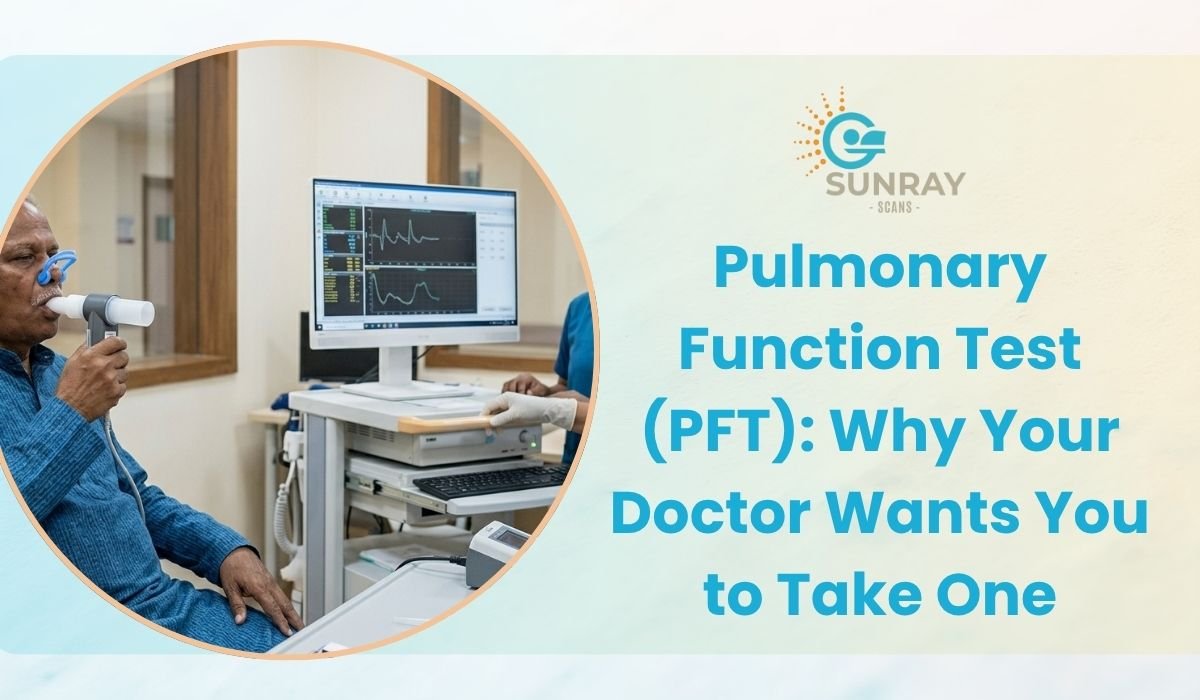
Spirometry is the most common type of lung test. During this procedure, you sit comfortably in a chair and wear a small, soft clip on your nose to ensure no air escapes through your nostrils. You are then asked to take a deep breath in and blow out as hard, fast, and completely as you can into a tube connected to a machine called a spirometer.
The machine records two primary numbers that give your doctor a clear view of your airways:
- Forced Vital Capacity (FVC): This measures the total amount of air you can forcefully exhale after taking the deepest breath possible.
- Forced Expiratory Volume in 1 Second (FEV1): This measures how much of that total air volume you can blast out during the very first second of your exhale.
By comparing your FEV1 and FVC numbers against standard health baselines based on your age, height, and gender, your doctor can immediately tell if your airways are narrowed, blocked, or restricted.
Top Reasons Your Doctor Recommended a PFT
Doctors order pulmonary function tests for a wide variety of clinical reasons, ranging from diagnosing new symptoms to clearing patients for major surgeries.
1. Diagnosing Chronic Symptoms
If you have been living with an unexplained cough, wheezing, or feeling out of breath after climbing a single flight of stairs, a PFT helps identify the root cause. It clearly distinguishes between different types of respiratory conditions, such as:
- Obstructive Lung Conditions: Disorders like asthma or Chronic Obstructive Pulmonary Disease (COPD), where the airways are narrowed, making it hard to exhale air quickly.
- Restrictive Lung Conditions: Issues like pulmonary fibrosis or chest wall stiffness, where the lung tissue cannot expand fully to hold a normal amount of air.
2. A Dedicated Breathing Test for Asthma
If your physician suspects asthma, a spirometry test is the absolute gold standard for confirmation.
During a breathing test for asthma, you will first perform a standard spirometry blow. Then, the technician will give you a quick puff of a bronchodilator inhaler (a medication that opens up relaxed airways). After waiting about 15 minutes, you repeat the test. If your airflow numbers improve significantly after using the inhaler, it strongly points toward asthma, allowing your doctor to prescribe the exact treatment you need.
3. Monitoring Existing Respiratory Conditions
If you have already been diagnosed with asthma, COPD, or occupational lung exposure from dust or industrial fumes, regular PFT checks act as a progress report. They show whether your current medications are working or if your lung capacity is changing over time.
4. Mandatory PFT Before Surgery
If you are scheduled for a major abdominal or cardiothoracic operation, your surgeon might request a PFT before surgery.
Going under general anesthesia temporarily alters how your diaphragm and lung muscles operate. A pre-operative PFT ensures your lungs are strong enough to handle anesthesia safely and helps your surgical team plan post-operative recovery to prevent complications like pneumonia.
Summary: What PFT Measures vs Other Tests
Feature | Chest X-Ray / CT Scan | Pulmonary Function Test (PFT) |
Primary Focus | Lung structure and physical anatomy | Airflow volume, speed, and lung strength |
Invasiveness | Non-invasive (uses low-dose radiation) | Non-invasive (uses natural breathing) |
Patient Action | Hold breath and stay still | Active deep breathing and forceful blowing |
Best Used For | Finding infections, fluid, or masses | Diagnosing asthma, COPD, and airway narrowing |
Duration | 5 to 15 minutes | 15 to 30 minutes |
How to Prepare for Your PFT Test
Preparing for a pulmonary function test requires minimal effort, but following a few basic guidelines ensures your test results are completely accurate:
- Medication Adjustments: Your doctor may ask you to temporarily stop using short-acting bronchodilator inhalers for 6 to 8 hours before the test so they do not alter the baseline reading. Always check with your physician before pausing any medication.
- Avoid Heavy Meals: Do not eat a large, heavy meal for at least two hours before your appointment. A full stomach presses against your diaphragm, making it difficult for your lungs to expand fully during deep breathing exercises.
- Dress Comfortably: Wear loose, comfortable clothing that does not squeeze your chest or stomach. Avoid tight belts or restrictive formal wear.
- Skip Nicotine and Caffeine: Avoid smoking, vaping, or consuming caffeine (coffee, tea, energy drinks) for at least 6 hours prior to your scan, as these can temporarily restrict your airways or alter your heart rate.
What to Expect During the Test
You will be guided through every step by an experienced technician. You may be asked to repeat the breathing maneuvers two or three times to ensure the computer collects consistent, reliable data. You might feel briefly lightheaded from blowing hard, but you can rest between attempts whenever you need to.
Why Choose Sunray Scans for Your PFT in Chennai
When your doctor requests a breathing test, you want an environment that prioritizes your comfort, accuracy, and hygiene.
For high-quality diagnostic services, visit Sunray Scans, a leading facility trusted by families across Tamil Nadu. Located in Royapettah, Sunray Scans provides a comprehensive suite of advanced diagnostic services, including digital computerized PFT testing, high-resolution imaging, and automated lab checks.
What Sets Sunray Scans Apart?
- Advanced Digital Equipment: State-of-the-art spirometry tools that deliver precise, error-free airflow measurements.
- Patient-First Hygiene: Single-use, disposable mouthpieces and sanitized equipment to ensure complete safety for every patient.
- Experienced Technologists: Gentle, trained technicians who guide you patiently through each breathing exercise to get the best results without causing fatigue.
- Fast, Comprehensive Reports: Quick turnaround times so you can take your digital reports straight to your pulmonologist or surgeon without delay.
Don’t ignore lingering breathing issues or delay your surgical prep. Talk to your physician, book your lung function check, and take a confident step toward better respiratory health today.