

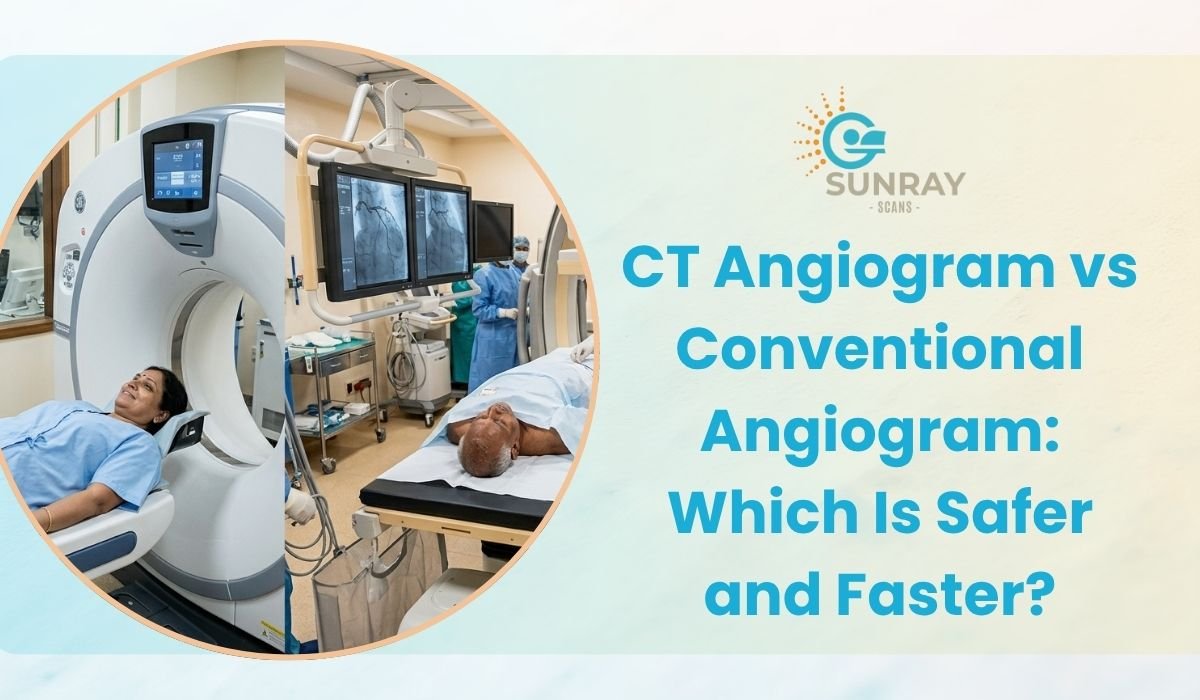
CT Angiogram vs Conventional Angiogram: Which Is Safer and Faster?
When a doctor mentions that you might have a problem with your heart or your blood vessels, it is normal to feel a sudden wave of worry. Your mind immediately starts racing with questions about treatments, tests, and medical procedures.
For many years, checking the blood vessels required checking into a hospital, getting a long plastic tube placed inside an artery, and spending hours recovering in a hospital bed. This traditional method is called a conventional angiogram.
Today, medical imaging has made major progress. Doctors now have a much gentler way to check your blood vessels from the outside. This modern method is called a computed tomography angiogram, or a CT angiogram.
If your doctor has recommended a check for blood vessel health, you might be trying to choose between these two diagnostic choices. Let us break down both tests in simple language, compare their safety and speed, and see why a CT angiogram Chennai session might be the most comfortable path for you.
The Basics: Angiogram vs Angioplasty
Before we compare the types of angiograms, it helps to clear up a common mix up in medical terms: the difference between an angiogram vs angioplasty.
- Angiogram: This is purely a diagnostic test. It acts like a camera to find a problem. The word tells you its job: “angio” means blood vessel, and “gram” means a picture or record. It helps your doctor check for plaque build up or structural issues.
- Angioplasty: This is a treatment procedure. If a doctor finds a severe blockage during a conventional test, they might immediately use an angioplasty to fix it. This involves using a tiny balloon to stretch open the blocked artery and placing a small metal mesh tube called a stent to keep the blood flowing freely.
Think of an angiogram as the mapmaker that finds the traffic jam, and an angioplasty as the road crew that clears it away.
What Is a Conventional Angiogram?
A conventional angiogram (also known as a catheter angiogram) is an invasive medical procedure. It is usually performed in a specialized hospital room called a cardiac catheterization lab.
During this test, a doctor numbs a small spot in your groin or your wrist. They make a small cut to reach a major artery. Then, they insert a long, thin, flexible plastic tube called a catheter into the artery. The doctor carefully pushes this tube all the way up through your blood vessels until it reaches your heart or the specific area they want to check.
Once the tube is in place, a special dye is injected directly into your blood vessels. This dye makes the blood flow visible on a live X-ray screen. The doctor watches the screen in real time to look for narrow spots or blocks. Because a tube enters your body, you usually need to stay at the hospital for several hours afterward with a heavy weight on your wrist or groin to make sure the artery closes and does not bleed.
[Small Cut in Wrist/Groin] ──> [Catheter Pushed to Heart] ──> [Dye Injected Inside] ──> [Live X-ray Monitoring]
What Is a CT Angiogram?
A CT angiogram is a modern, non-invasive alternative. It combines a standard computed tomography scanner with a simple intravenous (IV) line, making it much more like a regular blood test than a surgical procedure.
Instead of inserting a long tube into your deep arteries, the medical team places a small, simple needle into a vein in your arm, just like a routine blood draw. A special contrast dye is injected through this arm vein.
You then lie down on a comfortable table that smoothly glides into a large, ring shaped CT machine. As the machine turns around you, it takes thousands of fast, detailed X-ray pictures of your body from different angles. A powerful computer stitches these pictures together to create a 3D view of your blood vessels, showing every detail clearly from the outside.
[Simple IV Line in Arm] ──> [Dye Injected into Vein] ──> [Fast Scan in CT Ring] ──> [3D Picture of Blood Vessels]
Head-to-Head: Which Test Is Safer?
Safety is always the number one priority when it comes to medical tests. When we look at the physical steps of both procedures, a non-invasive heart scan using a CT machine holds a major safety advantage.
Risks of Conventional Angiograms
Because a conventional scan threads a physical tube through your arterial system, it carries a small but real risk of complications:
- Artery Damage: The tip of the plastic tube can accidentally scratch or tear the inner lining of your blood vessels.
- Bleeding Risks: Because the doctor must tap into a high pressure artery, stopping the bleeding after the test requires strict bed rest for four to six hours.
- Blood Clots: Moving a tube through blood vessels can occasionally disturb plaque pieces, which could lead to a stroke or a heart attack in rare cases.
Safety of a CT Angiogram
A CT angiogram removes almost all of these physical risks because no tubes enter your arterial system. The contrast dye goes into a superficial arm vein, meaning there is zero risk of artery damage, zero risk of internal tearing, and no chance of major bleeding issues. For patients who want to avoid the risks of invasive tests, the CT method offers excellent safety and peace of mind.
Head-to-Head: Which Test Is Faster?
In our busy lives, the amount of time a medical test takes can make a huge difference in our schedule and comfort.
Time Required for a Conventional Scan
A conventional angiogram is a major event that takes up most of your day:
- Preparation: You often need to arrive at the hospital hours early for blood checks and prep.
- The Procedure: The actual catheter test takes about 30 to 60 minutes.
- Recovery Time: After the test, you must lie completely flat in a hospital room for 4 to 6 hours to make sure the access site heals safely. You cannot drive yourself home and usually need to take a couple of days off from physical activity.
Time Required for a CT Scan
A CT scan is incredibly fast and fits easily into a regular day:
- The Scan: The actual scanning process takes less than 15 to 30 seconds. You only need to hold your breath for a few moments while the ring spins.
- Total Appointment Time: From entering the clinic, getting your IV line, taking the scan, and walking out, the entire process takes around 60 to 90 minutes.
- Zero Recovery Time: Once the scan is done, the IV needle is removed, and you can walk right out. You can drive yourself home, return to work, and continue your day normally.
Quick Comparison: CT vs Conventional Angiogram
Feature | CT Angiogram | Conventional Angiogram |
Invasiveness | Non-invasive (simple arm IV) | Invasive (catheter inside arteries) |
Actual Scan Time | 15 to 30 seconds | 30 to 60 minutes |
Hospital Stay | None (outpatient clinic visit) | Requires several hours of day care |
Recovery Period | Immediate (go back to work) | 4 to 6 hours of strict flat bed rest |
Primary Use | Finding blocks and checking health | Active treatment or urgent emergencies |
What Does CT Angiography Preparation Involve?
Getting ready for a CT scan is simple and stress free. Your clinic will provide you with easy instructions for your CT angiography preparation to make sure the pictures come out perfectly clear:
- Fasting: You will usually be asked not to eat anything for 4 hours before the scan, though clear liquids are usually fine.
- Hydration: Drinking plenty of water before and after your appointment is highly recommended, as it helps your kidneys flush the contrast dye out of your body quickly.
- Heart Rate Check: The CT machine captures the best pictures when your heart is beating at a calm, steady pace. Your doctor might ask you to avoid caffeine, tea, or energy drinks on the day of your test. Sometimes, the staff may give you a simple temporary pill to keep your pulse relaxed during the scan.
- Kidney Health: Because the contrast dye leaves your body through your urine, you will need a quick, simple blood test to check your kidney function before the procedure.
Checking Beyond the Heart: Peripheral Angiograms
While most people think of heart health when they hear the word angiogram, blood vessel health matters everywhere in your body.
If you experience persistent leg pain while walking, numbness in your feet, or slow healing sores, you might have a block in the blood vessels supplying your legs. Doctors call this Peripheral Artery Disease (PAD).
A CT machine can perform a vascular blockage scan on your legs, arms, or abdomen just as easily as it checks your heart. When looking into these tests, many patients naturally look up the peripheral angiogram cost to plan their medical budget.
Choosing a modern CT scan center is generally far more budget friendly than an invasive hospital procedure. Because a CT test does not require a hospital room, a surgical team, or hours of post-procedure nursery care, it provides highly precise diagnostic answers at a fraction of the cost of a traditional hospital stay.
The Verdict: Which One Do You Need?
With all these advantages, you might wonder why anyone still gets a conventional angiogram.
The answer comes down to whether you need a quick diagnosis or immediate treatment. If a patient is having an active emergency or if a doctor is certain they need to perform an angioplasty to clear a major block, a conventional angiogram is best because it allows the doctor to diagnose and treat the problem in the exact same step.
However, if you are looking to check your symptoms, screen for early blockages, rule out heart issues, or get a clear view of your vascular health without the fear and recovery time of a surgical procedure, a CT angiogram is the clear winner. It is safer, significantly faster, and much friendlier on your wallet.
Schedule Your Scan with Confidence in Chennai
If you are looking for an advanced, highly reliable diagnostic facility in Tamil Nadu, you can find premium care right in your neighbourhood.
For clear answers and an excellent patient experience, visit Sunray Scans, the premier center for a CT angiogram Chennai patients trust for top tier healthcare.
Located in Royapettah, Sunray Scans features cutting edge imaging technology that captures high resolution 3D views of your vascular system in seconds. Their expert medical team handles every step of your preparation with care, offering affordable rates and rapid report delivery so you can share the results with your doctor right away.
Do not let fear delay your vascular health check. Choose the modern, non-invasive path to clarity, protect your peace of mind, and take control of your well-being today.