

TMT Test (Treadmill Stress Test): What to Expect and Why Your Cardiologist Ordered It
When you visit a doctor for chest discomfort, shortness of breath, or a general heart checkup, you might expect them to take your blood pressure, listen to your chest with a stethoscope, and perform an electrocardiogram (ECG) while you lie down on an examination bed.
While a resting ECG provides valuable basic details, your heart behaves very differently when you are resting compared to when you are physically active.
Think of your heart like an automobile engine. When a car is idling smoothly in a parking lot, a mechanic might not notice any hidden mechanical issues. But once you take that car out on the highway, push the gas pedal, and drive up a steep hill, any underlying problems with the fuel lines or engine quickly become obvious.
Your heart works the same way. When you are sitting still, your heart muscle needs only a modest amount of blood and oxygen. But when you walk quickly, climb stairs, or exercise, your heart must pump significantly faster and harder. If an artery is partially blocked or narrowed, the blood supply cannot keep up with this higher demand, and signs of trouble start to show up.
This is exactly why doctors recommend a treadmill stress test heart evaluation. Commonly known as a Treadmill Test or TMT, this simple non invasive check gives your healthcare team a dynamic view of your cardiovascular health under exertion.
If your doctor has advised a TMT test Chennai appointment, let us walk through why this test is essential, how the procedure works step by step, and how you can prepare for a smooth, stress free experience.
What Exactly Is a TMT Test?
A TMT test for heart health, also known as a cardiac stress test or exercise stress test, is a diagnostic examination that measures how well your heart handles physical workload.
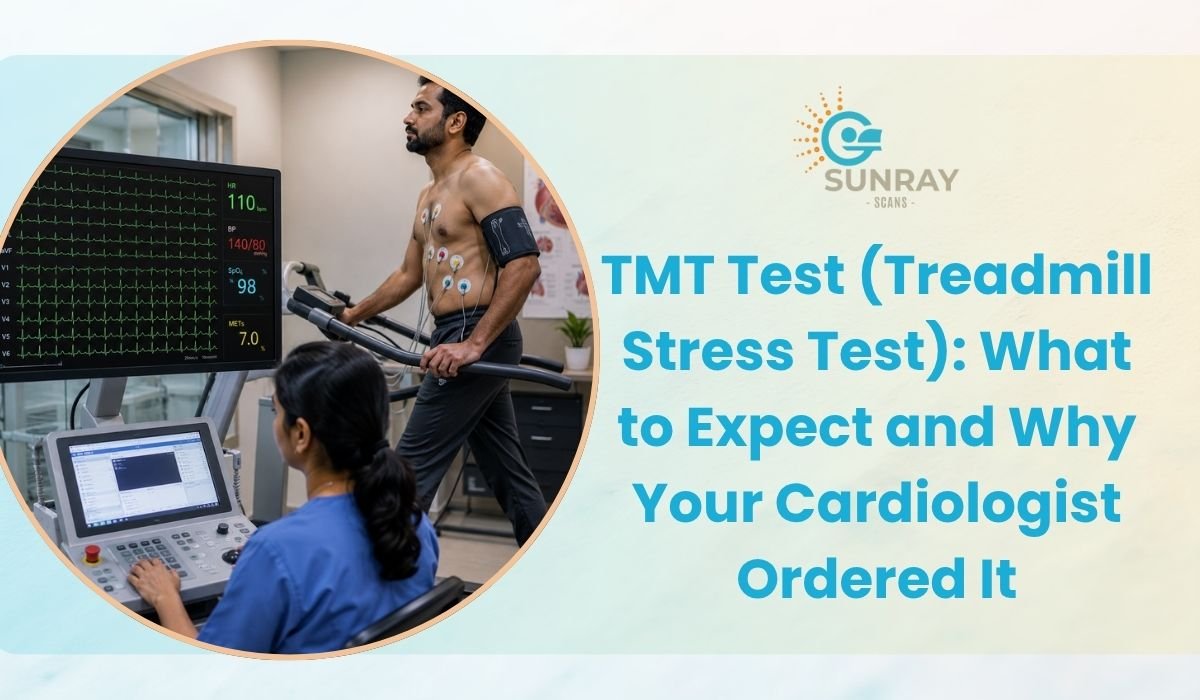
During the test, you walk on a motorized treadmill while medical equipment continuously records your heart rate, electrical heart rhythms, and blood pressure. As the test progresses, the treadmill gradually speeds up and tilts upward at set intervals, asking your heart to work harder in a controlled, safe environment.
By looking at your heart rhythms during both rest and peak effort, cardiologists can identify hidden blood flow restrictions, assess abnormal heartbeats (arrhythmias), and evaluate your overall physical fitness.
Top Reasons Your Cardiologist Recommended a TMT Test
Cardiologists order an exercise stress test for several important diagnostic and preventive reasons.
Diagnosing Coronary Artery Disease (CAD)
Coronary arteries are the vital blood vessels that supply oxygen rich blood directly to your heart muscle. Over years, cholesterol, fatty deposits, and calcium can build up inside these arteries, forming hard plaque that narrows the channel.
When you are seated on a sofa, enough blood might trickle past a 50 percent or 70 percent blockage to keep you feeling normal. But during exercise, that narrowed artery cannot deliver the extra oxygen your heart demands. This lack of blood flow causes specific electrical pattern changes on the ECG monitor, alerting the medical team to possible blockages before they trigger a heart attack.
Investigating Unexplained Chest Discomfort or Breathlessness
If you experience a vague tightness in your chest, unexplained heaviness across your shoulders, or sudden shortness of breath when walking up an incline, a TMT test helps pinpoint whether those symptoms come from your heart or from other sources like acid reflux, muscle strain, or lung issues.
Detecting Exercise Induced Arrhythmias
Some irregular heart rhythms (arrhythmias) stay completely hidden when you are resting and only show up when your heart beats rapidly during physical activity or stress. A continuous ECG tracing captures these rhythm disturbances right when they occur.
Evaluating Safe Exercise Levels After a Heart Event
If you have recently had a heart attack, underwent an angioplasty, or had bypass surgery, a stress test helps your doctor determine how much safe physical activity you can handle during your cardiac rehabilitation. It establishes clear guidelines for daily walking, sports, and workplace demands.
Pre-Operative Health Clearance
Before major non cardiac surgeries, doctors often order a treadmill stress test to confirm that a patient’s cardiovascular system is strong enough to handle general anesthesia and surgical stress safely.
How Does a TMT Test Compare with Other Heart Tests?
Patients often ask why they need a treadmill test if they have already completed a resting ECG or an echocardiogram. Each of these tools looks at a different aspect of your heart.
Diagnostic Test | What It Measures | Patient Activity Level | Primary Purpose |
Resting ECG | Baseline electrical activity | Completely still on a bed | Spots past heart attacks or resting rhythm issues |
Echocardiogram (2D Echo) | Physical heart muscle and valve movement | Lying down on your side | Checks heart chamber sizes and valve pumping strength |
TMT (Stress Test) | Electrical activity under physical exertion | Walking/Jogging on treadmill | Finds hidden blood vessel blocks and exercise capacity |
Holter Monitor | Continuous rhythm over 24 to 48 hours | Normal daily routine | Records sporadic, intermittent rhythm skips |
The TMT Test Procedure: What Happens Step by Step
Understanding the TMT test procedure in advance removes uncertainty and helps you feel confident throughout your appointment.
Step 1: Baseline Preparation and Skin Setup
When you arrive at the diagnostic center, a technician will ask you to remove your upper clothing and wear a comfortable clinic gown.
To ensure the recording stickers (electrodes) stick firmly to your skin and do not shift while you walk:
- Small patches on your chest may be gently cleaned or lightly shaved if needed.
- Ten adhesive electrode patches are placed across your chest and torso.
- These electrodes connect via thin wires to a digital ECG monitor.
- A blood pressure cuff is placed around your arm.
The technician first records your resting baseline blood pressure and resting ECG while you are lying down, sitting, and standing.
Step 2: The Exercise Phase (The Bruce Protocol)
Once your baseline numbers are recorded, you step onto the treadmill. The medical team uses a standardized medical program called the Bruce Protocol.
The test is divided into multiple stages, with each stage lasting three minutes:
- Stage 1 (Warm Up): The treadmill starts at a gentle, slow walking speed of 2.7 km/h with a mild 10 percent incline.
- Stage 2: The speed increases slightly to 4.0 km/h, and the incline rises to 12 percent.
- Stage 3: The speed increases to 5.4 km/h with a 14 percent incline, feeling like a brisk uphill walk or light jog.
- Further Stages: For athletes or individuals with high physical conditioning, speed and incline continue to rise every three minutes.
Throughout every stage, the computer tracks your heart rate and rhythm continuously, while the technician checks your blood pressure at regular intervals.
Step 3: Reaching Your Target Heart Rate
The goal of the test is not to run until total exhaustion. Instead, the test continues until you reach your Target Heart Rate (THR), which is generally calculated as 85 percent of your maximum predicted heart rate based on your age:
To find your target heart rate during an exercise stress test, doctors first estimate your maximum heart rate by subtracting your age from 220. Your target heart rate is then calculated as 85% of that maximum number. For example, for a 50-year-old person, the estimated maximum heart rate is 170 beats per minute (220 minus 50), which makes their 85% target heart rate 144.5 beats per minute.
Once you reach this target, or if you feel too tired to continue, the technician stops the treadmill.
Step 4: The Recovery Phase
After the treadmill stops, the test is not quite over. You will sit down or lie down immediately while the team continues monitoring your ECG and blood pressure for another five to ten minutes.
Watching how quickly your heart rate drops back to normal provides valuable information about your overall cardiovascular recovery and physical conditioning.
When Will the Test Be Stopped Early?
Your safety is always the highest priority during an exercise stress test. The medical doctor or technician supervising your test will stop the machine immediately if:
- You develop severe chest discomfort, arm pain, or jaw tightness.
- You experience severe dizziness, lightheadedness, or extreme breathlessness.
- Your blood pressure rises excessively high or suddenly drops.
- The ECG monitor shows dangerous heart rhythm abnormalities or acute lack of oxygen to the heart muscle.
- You simply request to stop because your legs feel too fatigued.
You are always in control, and you can tell the staff to pause the test whenever you feel uncomfortable.
How to Prepare for Your TMT Appointment
Getting ready for your treadmill test requires only a few basic steps to ensure accurate, safe results:
- Footwear and Clothes: Wear loose, comfortable walking clothes and running shoes or sneakers with good rubber grip. Avoid formal shoes, sandals, or loose slippers.
- Eating and Drinking: Avoid eating a large or heavy meal for two to three hours before the test. A light snack like a banana or a slice of toast an hour before is fine.
- Skip Stimulants: Do not consume coffee, tea, energy drinks, or nicotine products for at least four to six hours prior to your scan, as caffeine and nicotine artificially raise your heart rate and can skew your results.
- Review Your Medications: Certain heart and blood pressure medications, particularly beta blockers (like metoprolol or atenolol), slow down your heart rate and may prevent you from reaching your target during testing. Ask your prescribing doctor if you should pause your medicine on the morning of the test. Never stop medication without your doctor’s direct advice.
Quick Safety Checklist for Patients
Inform the diagnostic team before starting the treadmill if you have:
- Severe knee, hip, or lower back arthritis that makes walking on an incline difficult.
- A history of asthma or breathing difficulties during exercise.
- An active fever, cold, or viral infection on the day of the test.
Understanding Your TMT Test Results
After the test, a cardiologist reviews your complete ECG tracings, blood pressure patterns, and heart rate recovery curves. Your final report will usually fall into one of three categories:
Negative (Normal) Test
A “negative” result is good news. It means your heart reached its target workload without showing any signs of reduced blood flow, dangerous arrhythmias, or concerning blood pressure spikes. Your symptoms are unlikely to be caused by significant coronary blockages.
Positive (Abnormal) Test
A “positive” result means the ECG showed specific changes, such as ST-segment depression, during exercise, indicating that your heart muscle was not receiving enough oxygen at higher workloads. This suggests the presence of narrowed coronary arteries. Your cardiologist may recommend further checks, like a CT coronary angiogram or an invasive angiogram, to locate the exact blockage.
Inconclusive or Sub-Maximal Test
If you had to stop the test early due to leg fatigue, knee pain, or shortness of breath before reaching your target heart rate, the test may be marked as inconclusive. In such situations, your doctor might suggest an alternative check, such as a pharmacological stress test or a stress echocardiogram, where medication is used to simulate exercise while you rest.
Why Choose Sunray Scans for Your TMT Test in Chennai
When scheduling a heart check, you need a facility that offers modern computerized diagnostic equipment, clean environments, and qualified medical professionals who prioritize your safety.
For reliable diagnostic care, visit Sunray Scans, a trusted TMT test Chennai provider serving patients from their modern center in Royapettah.
Sunray Scans provides a complete range of cardiac and vascular diagnostic services, including digital TMT stress testing, high resolution 2D echocardiography, digital ECG, and multi-slice CT angiography. Their dedicated team of certified technicians and experienced cardiologists ensures that every stress test is conducted under strict clinical supervision with prompt, clear reporting.
Why Patients Choose Sunray Scans
- Advanced Digital Treadmill Systems: Precise automated speed and incline controls with clean, computerized multi-lead ECG tracking.
- Supervised Clinical Safety: Continuous medical monitoring throughout both exercise and recovery stages to ensure complete peace of mind.
- Integrated Heart Checks: Easy access to companion tests like 2D Echo, blood lipid profiles, and vascular imaging under one roof.
- Fast, Accurate Reports: Rapid digital report delivery so you can consult your treating cardiologist without unnecessary delays.
- Accessible and Transparent Pricing: Quality healthcare services at fair, competitive rates for individuals and families across Chennai.
Taking care of your heart starts with understanding how it performs when life demands more energy. If you have been experiencing unusual fatigue, chest discomfort, or simply want to check your fitness before starting a new workout routine, talk to your doctor about an exercise stress test. Taking this simple proactive step gives you clear answers and keeps your heart beating strong for years to come.